March 27, 2021
Aliens Among Us
|
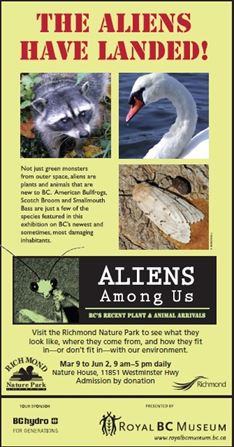
From March 9 to June 2 the Richmond
Nature Park Society is proud to host in partnership with the City of Richmond
and the Royal BC Museum the Aliens Among Us exhibition, sponsored by BC Hydro.
Not just green monsters
from outer space, aliens are plants and animals new to B.C. American Bullfrogs,
Scotch Broom, and Smallmouth Bass are just a few of the species featured in
this exhibition on B.C.'s newest and sometimes, most damaging inhabitants.
This exciting exhibit
showcases a number of invasive species that can be found in Richmond and
throughout the province. Stop by the Nature House to learn all about them!
Pictures to follow
soon!
James Greenhalgh
RNPS Board Member
Follow us
on Facebook for the latest and most up-to-date information and events!
|
September 25, 2020
Farewell to summer
|
Summer was a busy season at Richmond Nature
Park and we’re a bit behind on our blog so its time to catch up on our
news. Highlights of the season, in no
particular order, include:
- A variety of nature programs for children between the ages of 4
and 10. The programs were anything from half a day to 4 days in
length. Program topics included
everything from A to Z – literally! If you challenge 20 children on a bus
trip to come up with 4 different animals for each letter of the alphabet
you will hear about everything under the sun.
- Our summer leaders were excellent! They were (are!) talented,
professional and fun and provided the children (see above) with wonderful
summer memories. They weren’t here nearly long enough though and when we
said goodbye to them at the end of August it was a bit like a balloon had
burst – all that wonderful energy and enthusiasm went out the door with
them. I’d like to thank Meagan and Greg for a very special summer and wish
them well at university this term.
- Summer wouldn’t be possible without the assistance of a
marvellous group of volunteers. Most of our volunteers are youth from the
Richmond area that want to give something to their community while gaining
skills and work experience. We are truly blessed to attract such wonderful
volunteers so I hope you’ll all join me in a great big “thank you” for
their assistance.
- The Blueberry Tea and Sale was a great success. Our thanks to the BC Blueberry Council for
the berries and ABC Country Restaurant for pies (lots and lots of
scrumptiously juicy pies).
- There was a concert in the park this summer. A first for us and something we’d like
to repeat, as it was a lovely interlude for a summer’s eve. Watch for it again next year and plan to
bring a picnic dinner while you enjoy the music.
- 7 sculptures were installed in the gardens around the entry
deck at the visitor kiosk in August. These pieces, a set called “Green
Symphony”, are a celebration of nature through the eyes of school
children. We hope you’ll enjoy
them.
- For the past few years we’ve hosted international student
volunteers who come to Richmond for an opportunity to see a bit of Canada,
practice their English and lend a hand where needed. This year, 6 volunteers from France and
Japan have helped us with conservation projects that keep invasive plants
out of the bog. Thank you Clement, Laurent, Clementine, Mayu, Taiki and
Yuki. We are grateful for your help
and for teaching us about your countries.
And so, on to fall:
It felt like summer just a few days ago,
and technically it is still summer for a couple more weeks, but all the
signs of fall are here: days are getting
shorter, the summer birds have gone and the migrants are streaming through, and
plants are getting ready for winter and the approaching new year - leaves are
changing colour and their seeds are already set for spring.
If you’re reluctant to welcome autumn
there’s still time to enjoy something that we usually associate with summer. It’s hummingbirds. Rufous Hummingbirds nest in
the Nature Park each summer and have become very popular with local
birdwatchers and photographers. They
come in March, stay until August and by now are settling in to enjoy the sun in
a semi-tropical forest somewhere. But
there are still hummingbirds to be seen. Anna’s Hummingbirds are known to over
winter on the coast – possibly due to people who keep hummingbird feeders out
year round. It would appear that we’ve caught the attention of a small group of
these birds and are seeing them regularly at a feeder behind the Nature
House. They’re quite shy so we ask that
you respect their space by staying several meters away from the feeder while
you watch them. By the way, we still
have hummingbird feeders in the Nature House gift shop so you can buy one for
your garden or as a gift for someone else.
Changes to the playground:
The playground in the Nature Park is very
popular but quite dated and due for a change.
Richmond Parks Department is about to start work on a Family Play Space
that will feature new play structures and natural play features. The play space will be larger than the
existing play tower and will accommodate more children and a wider range of
ages. It will also include improvements to the nearby pond to allow access for
educational activities. Work will begin
the week of September 19 and continue, in stages, through 2012 and 2013. Stay tuned – this is going to be awesome.
I saved the best news for last – our
school programs are back!!
Our school programs were on hiatus last
year as the RNPS addressed financial challenges common to many not-for-profit
groups these days. But we’ve got a new
strategy and will be ready to take bookings by the end of September. Please note that this is a new beginning for
our school programs so they’ll be different than in previous years. Remember
that those programs took years to perfect so we’ll appreciate your support
while we finesse the new look. Teachers can call us on weekdays (604.718-6188)
for more information or to put your name on a wait list.
Posted by Kristine Bauder, Nature Park
Coordinator
|
August 5, 2021
Annual Blueberry and blueberry pie sale!
|
On a nice sunny day the Nature Park can be a wonderful place to visit and have a walk. However, many people don’t know that there is an east side to the park! Many are familiar with the Nature House and pond trails, but there is also a small trail system on the east side of the park next to the Auto Mall. Know as the Nature Study Area, it is a trail loop which is a bit of a different walk from those found on the west side of the park. Until recently the trail had not be as well maintained as the others but a few years ago, with the help of Microsoft volunteers, a boardwalk was added. Still, the trail remains a bit more challenging hike than the others but also provides a change in setting for those who may walk the park frequently. If you do choose to explore the east side of the park be careful about driving in to or out of the parking lot as the entrance is quite close to the right hand turn lane on Jacombs Road . Next time there’s a nice sunny day consider a walk in the park (on either side) and don’t forget your water and sun-screen! If you’re up for something a bit more relaxing consider attending our Blueberry Tea and Pony Rides on August 7 from 11 am to 4 pm. Have a cup of blueberry tea, enjoy a slice of blueberry pie (generously prepared by ABC Country Restaurant from blueberries donated by the BC Blueberry council), and for the little ones: Pony Rides! Remember to come early as the pie is often a popular sell-out.
Hope to see you there, have a great summer
– James Greenhalgh, Nature Park Society Board Member
|
July 17, 2021
Digital Signboard
|
Good News everyone! The grand unveiling of the artwork and digital signboard conceived and created by Jeanette Lee occurred on Tuesday July 12 at 7:00 pm. These wonderful pieces of artwork were originally created to accompany the sign on Westminster Highway , but it was decided that they would be appreciated far more as an addition to the garden. The artwork began with consultations between the artist and local school children on what they believed to be “Nature” and lead her to develop each of the unique pieces from reflections on those discussions. After many months of hard work in her studio (and eager anticipation on our part!) the sculptures have finally been installed. Come by the park either before or after the grand unveiling to see these fun additions to the garden, they are located just beside the Nature House around the wooden deck. Also keep an eye out for us at the Salmon Festival! We’ll be out with our Urban Wildlife collection again, stop by and find out about the animals that we share our neighbourhoods with.
Till then
– James Greenhalgh, Nature Park Society Board Member
|
June 19, 2021
Summer Time at the Nature Park
|
The summer is a busy time at the Richmond Nature Park . Recently we just had our annual Slug Fest and Race, saved from the dust-bin of history and given a reprieve for an other year (for those of you who haven’t followed the blog the society had planned on giving Slug Fest a well deserved retirement). We were lucky this year to have a beautiful sunny day, especially after so much rain, and a great turn out. The slugs were raced, winners were chosen, and everyone left with a greater appreciation for our slimy garden friends. Watch the Slug Fest video created by Chris Standley at http://therichmondreel.com/?p=658.
More recently, we also attended the Richmond Scouts 75th Anniversary Celebration at Minoru Park . Our Urban Wildlife taxidermy collection was well received and many people were interested to find out about what little creatures live in the pond behind the Nature House. To our surprise we even had a small fish in our bucket of pond water; surprising as it was taken from a vernal (or seasonal) pond which usually will dry up over the summer.
Also, you may have noticed pieces of sculptural artwork have been added to the entry garden at the front of the Nature House. Originally intended to compliment the new digital signboard these sculptures showcase visions of nature and make a welcome and attractive addition to the garden. Keep your eyes open for our announcement for the grand unveiling ceremony which will be happening soon! Till next time – James Greenhalgh, Nature Park Society Board Member
|
April 4, 2021
Richmond Nature Park Society's AGM is set on April 20th
|
Richmond Nature Park Society’s Annual General Meeting is taking place in the Nature House on April 20th at 6:00pm. This is a great opportunity for those of you who are interested in learning more about what we do and how to get involved! We are currently looking for new board members who will help shape our society programs and plan fun family events. For more information please call 604-718-6188 or e-mail
naturepark@richmond.ca.
Jenny Chen
Richmond Nature Park Board
|
March 12, 2021
Our first event of the year
|
|
Over 1100 visitors came through the doors of the Nature House last Sunday. Why? Because there were real live owls inside and how often do you get to see a real live nocturnal mystery?
Owls fascinate people. Glowing eyes, hauntingly silent flight and the seemingly magical ability to grab a tiny mouse in the deep dark woods confound earth bound humans who merely stumble blindly around in the dark.
How do owls do it? With finely honed adaptations that include exceptionally large eyes that capture the least bit of light (the better to see you with), remarkably keen hearing and asymmetrical ears that allow them to triangulate the exact location of a noise made by prey (the better to hear you with), feathers that feature a ruffled edge to eliminate the whistling noise of wings in flight (the better to sneak up on you with), large talons to grab and hold their reluctant prey and a sharp beak to quickly finish the job (the better to eat you with).
The Orphaned Wildlife Rehabilitation Society brought the owls to the Nature House as part of their efforts to inform and educate about owls. OWL looks after injured and orphaned birds of prey (hawks, eagles and owls) with the goal of rehabilitation and release. But rehabilitation requires habitat and habitat requires support from people – hence the educational component of OWLS work. The birds that appeared at the show are a select group of owls that, for one reason or another, cannot be released back into the wild. They are accustomed to appearing at programs and events throughout the lower mainland and are ambassadors from the owl kingdom to the human world.
We look forward to another visit from OWL in the fall. In the meantime you can look forward to other programs and events. The next show featuring unusual (for us) live animals in an Exotic Reptile Show on Saturday/Sunday, March 26 and 27, 11am-4 pm. Please remember that your donations make these events possible.
Posted by: Kris Bauder
Nature Park Coordinator
|
March 7, 2021
Spring Comes Winging in – On Hummingbirds
|
|
Spring has been a tease this year - playing hide and seek by showing a glimpse of sunshine and flowers only to hide it again behind clouds and a blanket of snow. We don’t “do” winter well here on the coast so are eager to shed our heavy jackets and get out to enjoy the warmer weather and longer days.
Although the first day of spring is still, officially, a few weeks away we said goodbye to winter when the first hummingbirds appeared on Feb.17. A pair of Anna’s Hummingbirds arrived at the feeders behind the Nature House and has been steady customers since then. This species is known to overwinter in the lower mainland where the usually mild winters and a steady supply of syrup from back yard bird feeders can see them through the cold lean time. Annas nest very early in the year (i.e. now) so as to avoid competition from the next species that will arrive on the scene.
Rufous Hummingbirds will soon return from their winter sojourn in California and Mexico. Ounce for ounce, Rufous are pugnacious little dynamos that will hog the syrup feeders, driving away anything, large or small, that they regard as competition in their nesting territory. Watch for Rufous on or about March 17 (maybe they’re Irish?). The month between the arrival of the different species is just enough time for the Anna’s to lay their eggs and see the babies out of the nest. When the Rufous arrive, the Anna’s make themselves scarce.
You’re welcome to stop by the Nature Park to view the hummingbirds. There are two feeders near the rear wall of the Nature House. We ask you to be considerate of the birds and stay 5 metres away from the feeders so as to avoid disturbing them while they feed. We love to see your photos – either in person in the Nature House or via email at naturepark@richmond.ca. If you have an especially good photo we may ask your permission to use it at the park.
Posted by: Kris Bauder
Nature Park Coordinator
|
November 7, 2020
A big Thank-you!
|
|
The Richmond Nature Park and the Richmond Nature Park Society would like to thank all the sponsors and volunteers that made Wild Things 2010 a huge success!
Sponsors who made Wild Things possible:
- Coast Capital Savings
- The City of Richmond
- Bob Wright Farms
- The Richmond Review
- Save-on-Foods
- Rona Home & Garden
- BC Place
- Old Navy
|
October 25, 2020
Report on Cranberry Sale
|
This weekend, Saturday October 9th and Sunday October 10th, the Richmond Nature Park Society hosted their annual Cranberry Sale. It was an amazing success with a complete sell out of the cranberries. Thank you to Ocean Spray for donating the cranberries and to everyone who came out and showed their support! The money fundraised is going to go towards the education programs run by the Richmond Nature Park Society. We, Tina and Jessica, as volunteers at Sunday’s event, found this experience to be fun, educational, and rewarding! We are now very much looking forward to the Wild Things Event, which is taking place Saturday, October 23rd from 5:30-8:30pm at the park. See you all there!
  
|
October 17, 2020
Wild Things
|
On Saturday, Oct. 23, Richmond Nature Park Society hosts the ninth annual Wild Things at the Richmond Nature Park. This fun-filled, exciting event for the entire family entails skits, live entertainment, story-telling, and a bit of spooky fun on the dark trails! Family and children will enjoy plays from their favourite witches and characters and have the opportunity to hear the popular tales of Halloween. Moreover, they will travel on the park trails and get interpretation about the wild things and animals that live in our urban neighbourhoods, such as racoons, squirrels, coyotes, frogs, owls and bats. There are many interesting facts to be learned and you would be surprised by how much your urban neighbourhood is immersed with its surrounding nature and creatures. Other fun Halloween activities include face-painting and pumpkin-carving.
Don’t miss out on this action-packed and entertaining evening. The event runs from 5:30 to 8:30PM. Admission is by donation and proceeds go directly towards public and school programs at the Nature Park. Light snacks and drinks will be available at vending booth. Dress warm in your costumes and you may choose to bring your own flashlight.
Wild Things is made possible with the generous support from Coast Capitals.
Jenny Chen
Richmond Nature Park Board
|
October 5, 2020
Cranberry Sale Fundraiser - Come out and show your support!
|
|
Stock up on fresh cranberries at the Richmond Nature Park Society’s annual cranberry sale. Recipes and cranberry sauce tasting are also available. Proceeds support educational and public programs at the Park. The event runs from 10am to 3pm on October 9th, Saturday, at the Richmond Nature Park.
Jenny Chen
Richmond Nature Park Board
|
September 19, 2020
Restoration Project
|
Take a walk around the boardwalk at the Richmond Nature Park and have a look at our latest project – restoration of the bog around the pond. This project is a joint venture of the Richmond Nature Park Society, the City of Richmond Parks Department, Walmart-EVERGREEN and a host of volunteers.
Cultivated blueberries are a particularly problematic plant in the Nature Park. Adapted, as they are for growth in bogs in eastern North America, they thrive in western bogs, too. Cultivated blueberries have been selected for vigorous growth so given the ideal conditions of our bog they quickly outgrow native plants, shading them into oblivion. There are other invasive plants in the bog but blueberries are the worst of the lot.
The impact of the blueberries has been especially apparent around our pond where they’ve grown into an impenetrable thicket. But we’re fighting back! Throughout the summer volunteers were busy cutting and removing blueberries. Many of our volunteers were from the Richmond area but 5 of them were student volunteers from France and Japan.
Last weekend, a group of engineering students from UBC deconstructed and removed the chain link fence that encircled one half of the pond. The removal of this fence will permit easier access to the pond and allow us to more effectively control the blueberries in the future.
This weekend a group of Richmond cadets will build a new split rail fence. The fence will be an attractive reminder for visitors to stay away from the edge of the pond. The next step in this project, a week from now, will be replanting the project zone with native bog species. Volunteers from Deloitte will assist with this task.
This project was made possible through funds from Walmart-Evergreen. Evergreen has been a generous supporter of past Nature Park projects. A grant in 2007 was a key element in the construction of a boardwalk through an impassably wet area in the Richmond Nature Study Centre.
When this project is over we will have restored half of the area surrounding the pond. We hope to do the other half next year. Please contact us if you would like to be involved with this project.
Submitted by Kris Bauder
Nature Park Coordinator
|
September 4, 2020
Nature Park Trails Re-opened
|
The trails are open! Thanks to the heavy rain on August 31 it is now safe to allow visitors into the park. Please note that the risk of fire is still considered high so smoking is not permitted anywhere in the Richmond Nature Park.
Kristine Bauder
Nature Park Coordinator
|
August 14, 2021
Attention: Trails Closed in Richmond Nature Park Due To Extreme Fire Hazard
|
The recent prolonged spell of hot dry weather has necessitated the closure of all the trails in the Richmond Nature Park and the Richmond Nature Study Centre. As bogs are highly susceptible to summer fires this closure will remain in effect until we have sufficient rain fall to penetrate the deep dry surface layer that has resulted from over 6 weeks of high temperatures without rain.
The Nature House, playground and picnic area remain open and all programs and events are going ahead as planned.
For more information or updates on the trail closures please call the Richmond Nature House at 604.718-6188.
|
|
Archives |
 Richmond Nature Park Society


